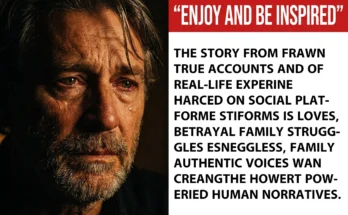
My hands trembled as I read the note again, hoping the words might somehow rearrange themselves into something less cruel.
The afternoon sun beat down on my weary body as I stood there, still in my hospital clothes, staring at the house I had called home for the past 3 years.
I knocked. Of course I did.
I knocked until my knuckles hurt, calling Charles’s name over and over. My son, my only child, the one I had raised alone after his father died when he was just 12.
But the only response was silence and the distant sound of Lucy’s voice instructing the children to be quiet.
Eventually, a curtain moved slightly, and I caught a glimpse of my 8-year-old grandson’s face before Lucy yanked him away.
The curtain fell back into place, and that’s when I knew they really weren’t going to let me in.
I sat down on my suitcase, trying to make sense of it all.
Three years ago, after Harold passed away, Charles and Lucy had suggested I sell my house and move in with them.
“Mom, it makes perfect sense,” Charles had said. “You’ll help with the kids. We’ll take care of you as you get older, and the money from your house can go toward expanding hours.”
It had seemed like such a good idea at the time.
$178,000.
That’s how much I had contributed to their home renovations.
Almost everything from the sale of the modest house Harold and I had paid off over 30 years.
“It’s an investment in our family,” Charles had assured me.
And I believed him.
I remembered how things had changed gradually.
At first, I was Grandma Alice, the beloved matriarch who made Sunday pancakes and helped with homework.
Then I became Mom, useful for babysitting and cooking dinner while Lucy pursued her self-care routine.
And finally, I was just Alice, the inconvenient old woman who took up space in their beautiful home.
The changes in Lucy were the most noticeable.
The warm smiles became tight-lipped nods.
The “thank you for watching the kids” became, “That’s what grandmothers are for.”
The invitations to family outings slowly dwindled until I was just the babysitter they left behind.
I pulled my phone from my purse and called Charles’s number.
Straight to voicemail.
I tried again.
Same result.
A text message would have to do.
“Charles, I’m outside the house. I just had surgery. Please let me in.”
I watched the message change from delivered to read.
No response came.
The afternoon sun began to set, and with it the reality of my situation sank in.
I was 68 years old, recovering from gallbladder surgery with nowhere to go.
The hospital had discharged me with instructions for home care, never imagining home would no longer exist for me.
As the evening chill set in, I finally accepted that no one was coming to open the door.
With shaking hands, I pulled the handle of my suitcase up and began walking.
Each step sent pain through my abdomen where the surgical incisions were still healing.
I had $43 in my wallet, enough for a cab at least, but to where?
A hotel would quickly drain what little cash I had on hand.
My sister lived three states away.
My closest friend, Die, had moved to a smaller apartment after her husband died.
I stopped at a bench at the bus stop, setting my suitcase beside me.
An overwhelming sense of betrayal washed over me, bringing tears I couldn’t hold back.
How could Charles do this?
The boy who once made me Mother’s Day cards with glitter and told me I was his hero.
The young man I’d worked two jobs to put through college.
My son.
And Lucy.
I had tried so hard with Lucy.
Respected her parenting decisions, never overstepped, helped whenever asked.
I thought we had built a relationship, if not of love, than at least of mutual respect.
The cruelty of the timing wasn’t lost on me.
They had waited until I was at my most vulnerable, fresh from surgery, to discard me.
Had they planned this all along?
Was I just a convenient source of child care and money until I became too much of a burden?
As the street lights flickered on, I pulled out my phone again and scrolled through my contacts.
My fingers hovered over Doie’s name.
We had been friends for over 40 years through marriages, children, and now widowhood.
If anyone would understand, it would be her.
The phone rang three times before her familiar voice answered.
“Alice, is everything all right?”
I tried to speak, but a sob escaped instead.
“Alice, what’s wrong? Weren’t you having surgery today?”
“Doy?” I finally managed, my voice barely above a whisper. “I need help. They… They’ve locked me out.”
There was a brief silence, then voice, firm and clear.
“Tell me where you are. I’m coming to get you.”
As I sat waiting for my oldest friend to rescue me, I watched a young family walk by.
The mother held her son’s hand, laughing at something he said.
Such a simple moment of connection.
It struck me then how completely my own family had severed our bonds.
How disposable I had become to them.
I closed my eyes, feeling the weight of betrayal press down on me, heavier than my suitcase, heavier than all my years combined.
Doy’s spare room wasn’t much, just a twin bed, a small dresser, and a reading lamp.
But that night, it felt like a sanctuary.
My surgical incisions throbbed as Doie helped me settle in, her face a mask of contained fury.
“I can’t believe Charles would do this,” she said, arranging pillows behind my back. “After everything you’ve done for that boy.”
I couldn’t either, but the evidence was undeniable.
My suitcase, hastily packed by Lucy with only some of my clothes and none of my cherished possessions, sat in the corner like a testament to my new reality.
“Have you tried calling him again?” Doy asked, handing me a cup of chamomile tea.
I nodded, taking the warm mug with trembling hands.
“17 times. He’s read my texts but hasn’t responded.”
Doie sat on the edge of the bed, her gray hair catching the lamplight.
We’d been friends since our 20s, back when we were both young mothers, figuring out how to balance work and family.
She’d been there when Harold died, and now she was here for this, my unceremonious eviction from my son’s life.
“You need to rest,” she said firmly. “Tomorrow, we’ll figure this out.”
But sleep proved elusive.
Every time I closed my eyes, I saw Lucy’s handwriting on that Post-it note.
“Now it’s just the three of us.”
The casual cruelty of it made my chest ache more than my surgical wounds.
Morning came with rain pattering against the window.
I checked my phone again.
No messages from Charles, no missed calls, just the digital silence of abandonment.
“Let’s have some breakfast,” Doie said, appearing in the doorway. “Then we need to talk about next steps.”
Over coffee and toast, I told Doy everything.
How I’d sold my house to help Charles and Lucy.
How the renovations had expanded their home from a modest three-bedroom to a spacious 5-bedroom with a gourmet kitchen and master suite.
“I put in almost $180,000,” I said, stirring my coffee absently. “Charles said it was an investment in our future together, that I’d always have a home with them.”
Doy’s expression darkened.
“Did you get anything in writing? Any legal agreement?”
I shook my head.
“He’s my son, Die. I trusted him.”
The words hung in the air between us.
Their naivity painfully obvious now.
“We should check your accounts,” Doie suggested gently. “Make sure they don’t have access to anything else.”
My stomach dropped.
I hadn’t even thought of that.
Charles had helped me set up online banking after Harold died.
For emergencies, he’d said he should be able to access my accounts, and I’d given Lucy my credit card for groceries and things for the grandkids.
With shaking hands, I logged into my bank account on Doiey’s tablet.
Relief washed over me when I saw my savings were untouched.
But when I clicked on my credit card statement, that relief evaporated.
$3,200 at Nordstrom.
$1,700 at some place called Sephora.
Doy read over my shoulder.
“When did you become such a big spender, Alice?”
“I didn’t,” I whispered, scrolling through charge after charge.
Designer clothes, expensive makeup, dining at restaurants I’d never heard of, all in the past 3 weeks while I was preparing for surgery.
The most recent charge had posted yesterday.
$4,500 at a place called Elite Furniture Gallery.
“They’re redecorating my room,” I realized, the pieces falling into place. “They were planning this, waiting until I was out of the house to replace my furniture.”
Doy’s face flushed with anger.
“Those ungrateful little—”
“I need to cancel these cards,” I cut in, a strange calm settling over me.
It was the first decisive feeling I’d had since finding my suitcase on the doorstep.
“I need to freeze everything.”
With Doie’s help, I called the bank.
Yes, I wanted to report card misuse.
Yes, I wanted to dispute the recent charges.
And yes, I wanted to freeze all my credit cards immediately.
“Ma’am, this will prevent any new charges from being approved,” the bank representative warned.
“Good,” I said firmly. “That’s exactly what I want.”
After hanging up, I sat back, exhausted, but feeling something I hadn’t expected.
A tiny spark of power.
I might have been thrown away like yesterday’s trash.
But I still had control over some things.
“What now?” Doie asked, squeezing my hand.
“I need to get my things,” I said. “My photo albums, Harold’s watch, my mother’s china. They’re still in that house.”
“We’ll figure it out,” Doie promised. “But first, you need to heal. Doctor’s orders.”
She was right.
Of course.
My body needed time to recover from surgery.
But as I leaned back against the pillows, I realized my heart would need much longer.
The next day, my phone rang.
Charles’s name flashed on the screen.
My heart leapt.
Perhaps he’d come to his senses.
Perhaps he was calling to apologize, to beg me to come home.
I answered on the second ring.
“Charles?”
“Mom.”
His voice was tight, controlled.
Not the voice of a remorseful son.
“There seems to be a problem with your credit cards.”
No “How are you feeling after surgery?”
No “I’m sorry we locked you out.”
Just concern about the cards.
“Yes,” I said, surprised by the steadiness of my own voice. “I’ve frozen them.”
A pause.
“Lucy was trying to buy groceries for the kids,” he said, an edge creeping into his tone. “The card was declined.”
“Was she also buying groceries at Nordstrom and Elite Furniture Gallery?” I asked. “Or was that something else?”
Another pause, longer this time.
“Mom, you authorized Lucy to use those cards for emergencies and necessities.”
“Corrected him. Not for thousands of dollars of whatever she’s been buying.”
I heard him inhale sharply.
“Look, I don’t have time for this right now. Just unfreeze the cards. We can talk about spending limits later.”
The dismissiveness in his voice ignited something in me.
A slow burning anger that had been building since I saw that Post-it note.
“No, Charles,” I said quietly. “I don’t think I will.”
“Excuse me?”
The surprise in his voice was almost gratifying.
“You’ve made it clear I’m no longer part of your household,” I continued, each word deliberate. “So, I’m afraid Lucy will have to find another way to pay for her shopping sprees.”
“Mom, be reasonable.”
“I was reasonable when I sold my house to help you expand yours,” I interrupted. “I was reasonable when I watched your children everyday while you and Lucy pursued your careers. I was reasonable when I cooked and cleaned and made myself useful. Where has all that reasonableness gotten me, Charles?”
Silence again, then:
“This isn’t a good time to discuss this.”
“It never is with you,” I said, the truth of it settling heavily in my chest. “Goodbye, Charles.”
I hung up, my hand trembling, but my resolve firmer than ever.
In the doorway, Doy stood watching, a small smile on her face.
“Well,” she said. “Look who finally found her backbone.”
I managed a weak smile in return.
“Freezing the cards is just the beginning,” I said. “I need to find out what else they’ve been doing with my money.”
As I spoke, a text message appeared on my phone.
“Charles, this is childish. Mom, call me when. You’re ready to be an adult about this.”
I showed the message to Die, who snorted in disbelief.
“The irony of him calling you childish,” she muttered, “after what they did.”
I set the phone down, a strange calm settling over me.
The initial shock and hurt were still there, but something else was emerging.
Determination.
They had taken my home, my security, and my place in the family.
But they wouldn’t take anything else from me.
Not one more penny.
Not one more shred of my dignity.
A week passed with no word from Charles.
My surgical incisions were healing, but the wound of betrayal remained raw and open.
Doy had been my lifeline, but I couldn’t impose on her forever.
I needed to retrieve my belongings and figure out my next steps.
“I’m coming with you,” Die insisted when I mentioned going back to Charles’s house.
“You don’t have to.”
“I absolutely do,” she cut me off, grabbing her car keys. “Besides, they’re less likely to slam the door in your face if there’s a witness.”
The familiar drive to the house I’d called home for 3 years felt surreal now.
As we pulled up, I noticed Lucy’s sleek SUV was gone.
But Charles’s sedan sat in the driveway.
“Perfect,” Dottie muttered. “Maybe we can talk some sense into him without her poisoning the well.”
My legs felt heavy as I walked up the pathway.
The flower beds I’d so carefully tended were already showing signs of neglect.
I rang the doorbell, my heart hammering against my ribs.
Charles opened the door, surprise flickering across his face before settling into a guarded expression.
He looked tired with dark circles under his eyes.
“Mom.”
He glanced at Die, then back to me.
“I didn’t expect to see you.”
“Obviously,” I replied, finding strength in Dottie’s solid presence beside me. “I’ve come for my things, my personal belongings.”
He hesitated, then stepped back.
“Lucy’s not here. She took the kids to her mother’s.”
The house looked different somehow.
Furniture had been rearranged, and a large modern sectional sofa now dominated the living room, presumably the purchase from Elite Furniture Gallery.
“My things are in the guest room,” I said, starting toward the stairs.
“Actually,” Charles said, clearing his throat. “We’ve moved some stuff around. Lucy’s using that room as her home office now.”
A chill ran through me.
“And my belongings?”
“Most of them are in boxes in the garage,” he replied, not meeting my eyes. “Lucy thought it would be easier for you to pick them up that way.”
Doie made a disgusted sound.
“How considerate of her.”
We followed Charles to the garage where several cardboard boxes sat stacked against the wall.
I approached them with trepidation.
The first box contained clothes hastily folded.
The second held books and some toiletries, but as I searched through the remaining boxes, panic began to rise in my throat.
“Where are my photo albums? Harold’s watch? My mother’s jewelry?”
Charles shifted uncomfortably.
“I’m not sure. Lucy packed everything.”
“Well, they’re not here,” I said, my voice rising. “And what about my mother’s china? The family heirlooms.”
“Mom, calm down.”
“Don’t tell me to calm down,” I snapped, surprising even myself with the force of my anger. “Those things are irreplaceable. They’re my memories, my history.”
Doie stepped forward.
“Charles, this is unacceptable. Those are Alice’s personal possessions.”
Charles ran a hand through his hair, looking more like a scolded child than a grown man.
“I’ll talk to Lucy. Maybe she put them somewhere else.”
“I want to look upstairs,” I insisted. “Now.”
He hesitated, then nodded reluctantly.
I headed straight for the attic, remembering I’d stored some older belongings there.
As I climbed the stairs, Charles’s phone rang.
He answered it in the hallway below, his voice low.
The attic was dusty and dim, but I knew exactly where I’d placed my storage trunks.
To my relief, they were still there, untouched.
I opened the largest one and found my wedding album, Harold’s military medals, and several family photo albums.
At least these precious memories had been spared Lucy’s purge.
As I gathered what I could carry, I overheard Charles’s conversation drifting up from below.
“No, she just showed up. Yes, with that friend of hers. I know what we agreed, but what was I supposed to do? She’s still my mother.”
There was a pause.
“Lucy, that’s not fair. We discussed waiting until after we sold the house to tell her about the nursing home. No, I haven’t told her yet. She just had surgery, for God’s sake.”
My blood ran cold.
Nursing home?
Selling the house?
I moved closer to the attic stairs, straining to hear.
“The real estate agent said we could get at least $650,000 with the renovations. Yes, enough to pay off our debts and put a down payment on the lakehouse. I know Mom’s money made it possible, but she agreed to invest in the property.”
My legs nearly gave out beneath me.
They were planning to sell the house, the house I had poured my life savings into, and move to a lake house.
And they wanted to put me in a nursing home.
I must have made a noise because Charles suddenly went silent.
“I have to go,” he said hurriedly. “She might have heard me.”
I scrambled back to the trunk, my mind reeling.
As Charles’s footsteps approached the attic stairs, I busied myself with the photo albums, trying to control my shaking hands.
“Mom, did, uh, you find what you were looking for?”
His voice sounded strained.
“Some of it,” I replied, not trusting myself to say more.
He helped me carry down what I’d found, an awkward silence stretching between us.
In the garage, Doy was methodically going through the remaining boxes.
“Charles,” I said finally, “were you planning to tell me about selling the house?”
His face went pale.
“You heard?”
“Yes, I heard. Just like I heard about the nursing home you’ve picked out for me.”
My voice was surprisingly steady despite the storm raging inside me.
“Were you even going to consult me about any of this?”
Charles at least had the decency to look ashamed.
“Mom, it’s not what you think. We just thought with your health issues—”
“My gallbladder surgery?” I interrupted. “That’s hardly a reason to ship me off to a nursing home. I’m 68, not 98.”
“It’s just, Lucy thought—”
“Lucy thought,” I repeated bitterly. “And you just went along with it, didn’t you? Just like you went along with kicking me out of my own home.”
“It’s not your home,” he said, a flash of defiance crossing his face. “Your name isn’t on the deed.”
The words hit me like a physical blow.
He was right.
Despite my substantial financial contribution, I had no legal claim to the house.
I had trusted my son, and that trust had been my downfall.
Doie stepped in, her voice icy.
“We’re taking these boxes now. And Charles, I suggest you find your mother’s missing valuables before we’re forced to involve the authorities.”
As we loaded the boxes into Doiey’s car, I caught a glimpse of papers on Charles’s desk through the open garage door.
A brochure for Sunny Pines’s assisted living lay beside what looked like real estate listings.
They had been planning this for months.
My eviction, the nursing home, the lakehouse, all of it calculated, all of it behind my back.
The betrayal cut so deep that I could barely breathe as we drove away.
But beneath the pain, something else was stirring.
A fierce determination that surprised me with its intensity.
They had taken everything from me.
But they wouldn’t determine my future.
Not anymore.
“You can stay with me as long as you need,” Do insisted as we unloaded the boxes from her car. “I mean it, Alice.”
I loved her for the offer, but I knew it wasn’t a long-term solution.
Do’s one-bedroom apartment was barely big enough for her, let alone a second person.
Besides, I needed to stand on my own two feet again.
“I appreciate that more than you know,” I told her. “But I need to figure this out for myself.”
The next morning, I made an appointment with the bank.
Martin Geller had been my financial adviser since Harold died, and his face registered genuine shock when I told him what had happened.
“I’m so sorry, Alice,” he said, reviewing my accounts. “The good news is that your pension and social security deposits are still coming in regularly, and your primary savings account is intact.”
“What about the money I put into Charles’s house?”
Martin’s expression turned grim.
“Without a formal agreement, it’s legally considered a gift. We might be able to pursue some options, but it would be an uphill battle.”
I nodded, having expected as much.
“Then I need to focus on moving forward. What can I afford for housing?”
We spent the next hour going over numbers.
My monthly pension and social security came to just under $2,400.
Not lavish, but enough to rent a modest apartment and cover basic expenses if I was careful.
“There’s also this,” Martin said, pulling up another account I’d almost forgotten. “Harold’s life insurance policy that you invested. It’s grown to about $42,000.”
A wave of gratitude for my practical, forwardthinking husband washed over me.
Even from beyond the grave, Harold was still taking care of me.
“That gives you options,” Martin continued. “You could use some of it for a rental deposit and furnishings and keep the rest as an emergency fund.”
As I left the bank, I felt a strange mixture of loss and possibility.
I had less than I’d thought I would at this stage of my life, but more than many people in my situation.
I could rebuild.
Over the next two weeks, I threw myself into apartment hunting.
Doie drove me to viewings, helped me compare prices, and kept my spirits up when despair threatened to overwhelm me.
Eventually, we found a small one-bedroom apartment in a senior living community.
It wasn’t fancy, but it was clean, had a small balcony for potted plants, and most importantly, it was affordable.
“It’s perfect,” Die declared when we first saw it. “And look, they have a community garden and weekly card games in the common room.”
I signed the lease that day.
A strange sense of accomplishment flowing through me for the first time since finding my suitcase on the doorstep.
I felt like I was taking control of my life rather than just reacting to disaster.
Moving in was another challenge.
With limited funds, I couldn’t replace all the furniture I’d left behind at Charles’s house.
But Doy’s church group came through with donated basics.
A gently used couch, a small dining table, and a comfortable recliner.
I bought a new mattress and bedding, one luxury I couldn’t compromise on.
And slowly, the apartment began to feel like mine.
My phone remained stubbornly silent.
No calls from Charles, no texts checking how I was doing, just silence.
I told myself it was better this way.
A clean break.
But at night, when the apartment was quiet and still unfamiliar, I would find myself wondering how my grandchildren were, whether they asked about me, what Charles had told them about my sudden disappearance.
3 weeks after moving into my new place, I was arranging my rescued photo albums on a bookshelf when my phone rang.
Charles’s name flashed on the screen.
My heart jumped, a treacherous spark of hope flaring despite everything.
“Hello,” I answered, trying to keep my voice neutral.
“Mom.”
His tone was all business, no warmth.
“We need to talk about your credit cards.”
Not “How are you” or “I’m sorry,” just straight to money matters.
“What about them?” I asked, the spark of hope extinguishing as quickly as it had ignited.
“They’re still frozen. Lucy needs to buy things for the kids.”
“No,” I interrupted, surprising myself with my firmness. “Those cards are staying frozen, Charles. I’m on a fixed income now, and I can’t afford to finance Lucy’s shopping habits.”
There was a pause, then:
“Mom, be reasonable. We’re family.”
The word family hit me like a slap.
“Family?” I repeated. “Is that what you call it when you throw your mother out after surgery? When you plot to sell the house she helped pay for and ship her off to a nursing home?”
“You don’t understand.”
“No, you don’t understand,” I cut in. “I trusted you with everything I had, Charles. My home, my money, my heart, and you betrayed that trust completely. I won’t give you another penny.”
His voice hardened.
“Then I guess there’s nothing left to discuss.”
“I guess not,” I agreed, a strange calm settling over me. “Goodbye, Charles.”
After hanging up, I sat in my new recliner, looking around at my small but dignified apartment.
Not the retirement I had planned, but mine nonetheless.
The phone call had been painful, but also clarifying.
Charles hadn’t called to reconcile.
He’d called for access to my money, nothing more.
That weekend, I discovered a flyer in the community room advertising a support group for seniors.
Life transitions, finding your way forward.
Something about it called to me, and the following Tuesday, I found myself walking into a sunny room at the local community center where six other seniors sat in a circle of chairs.
Nancy, the group facilitator, welcomed me warmly.
“Would you like to introduce yourself and share a little about what brought you here?”
I hesitated, then began speaking.
“My name is Alice. A month ago, my son and daughter-in-law locked me out of their house after I had surgery. I’d sold my own home to help them, and they—”
My voice cracked, but I pushed on.
“They decided I was no longer useful to them.”
The sympathetic faces around me gave me courage to continue.
I told them everything.
The betrayal, the nursing home plans, the frozen credit cards, my new apartment.
As I spoke, I realized it was the first time I’d told the full story from beginning to end.
And something in me shifted.
The shame I’d been carrying.
The sense that I must have done something to deserve this treatment began to dissolve.
“Thank you for sharing that, Alice,” Nancy said when I finished. “Unfortunately, elder financial abuse often comes from family members. What you’re experiencing is more common than many people realize.”
A silver-haired woman named Eleanor reached over and squeezed my hand.
“My daughter did something similar,” she confided. “It took me years to rebuild, but I did it. And so will you.”
As the meeting continued, others shared their stories.
Some similar to mine, others different but equally challenging.
By the time we broke for coffee and cookies, I felt something I hadn’t expected.
A sense of community.
These people understood what I was going through without judgment or pity.
When I left the meeting, I had three phone numbers and an invitation to join Eleanor and another woman named Margaret for lunch the following week.
Back in my apartment, I stood on my small balcony, watching the sunset paint the sky in brilliant oranges and pinks.
For the first time, I allowed myself to imagine a future different from the one I’d planned.
Not lesser, just different.
A future where I made my own decisions, built new friendships, and learned to trust again carefully and selectively.
It wouldn’t be easy.
The pain of Charles’s betrayal still cut deep.
But standing there in the fading light, I felt something unfamiliar stirring within me.
Not just survival, but the possibility of thriving.
6 months passed.
Autumn turned to winter, and winter softened into spring.
My little apartment had become a true home, decorated with treasured photos and a few carefully chosen new pieces.
The support group had become a lifeline, and Elellanar and Margaret were now dear friends.
We met weekly for coffee, card games, or walks in the park when weather permitted.
My life had developed a peaceful rhythm until the day I received an unexpected letter from a real estate agency.
“Congratulations on the sale of your property,” it began, listing an address I recognized immediately.
Charles’s house.
My hands trembled as I read on.
The letter was addressed to me as a co-investor in the property, informing me that the house had sold for $685,000.
I stared at the paper in disbelief.
They had done it.
They had actually sold the house, the house I had poured my life savings into, and they had somehow used my name in the process.
I called Doie immediately.
“They sold the house,” I said, my voice shaking. “And somehow they’ve listed me as involved in the sale.”
“That’s impossible,” Doie said. “Your name isn’t on the deed. How could they?”
She stopped.
“Unless they forged something. Alice, you need to talk to a lawyer.”
The next day, I sat across from Patricia Winters, an attorney specializing in elder law, whom Eleanor had recommended.
She reviewed the letter with a deepening frown.
“This is concerning,” she said. “They couldn’t legally sell the house using your name as a co-owner unless there’s documentation with your signature. Did you ever sign anything regarding the house?”
I thought back.
“Charles had me sign some papers when I first moved in. He said it was for tax purposes, for the money I contributed.”
Patricia nodded grimly.
“I’d like to investigate this further. Meanwhile, I suggest we arrange a meeting with Charles and Lucy. If they’ve committed fraud, they need to know there will be consequences.”
The thought of confronting them sent a wave of anxiety through me, but also a strange sense of anticipation.
For months, I had been rebuilding my life, finding my strength.
Perhaps it was time to show them exactly who I had become.
Patricia helped me draft a formal letter requesting a meeting.
We sent it by certified mail to ensure they couldn’t claim they never received it.
3 days later, Charles called.
“What’s this about, Mom?” he demanded, his voice tense. “Why are you involving a lawyer?”
“I think you know exactly what it’s about,” I replied calmly. “The house sale.”
A pause.
“That’s our business, not yours.”
“Not according to the letter I received congratulating me on the sale,” I countered. “Somehow my name was involved in a transaction I knew nothing about.”
He sighed heavily.
“Fine, we can meet, but leave the lawyer out of it. This is family business.”
“The time for handling things as family passed when you put my suitcase on the doorstep, Charles,” I said, surprising myself with my steadiness. “Patricia will be there, and I suggest you bring your own legal representation.”
We arranged to meet at a neutral location, a private room at a local restaurant.
I spent the days leading up to it, alternating between anxiety and a strange, fierce determination.
The night before, Elellaner called to check on me.
“Remember,” she said, “you’re not just fighting for your money. You’re fighting for your dignity. Don’t let them see you waver.”
The morning of the meeting, I dressed carefully in a blue dress that Doy said brought out my eyes, applied light makeup, and styled my hair.
Looking in the mirror, I barely recognized the confident woman staring back at me.
Six months ago, I had been broken, betrayed, and homeless.
Today, I stood tall, ready to face those who had tried to destroy me.
Patricia picked me up, reviewing our strategy as we drove.
“Let them talk first,” she advised. “People often reveal more than they intend when they’re defensive.”
Charles and Lucy were already seated when we arrived, along with a thin man Patricia identified as James Porter, a local attorney known for real estate transactions.
Lucy looked tense, her usual polished appearance slightly frayed at the edges.
Charles wouldn’t meet my eyes.
“Thank you for coming,” Patricia began, setting a folder on the table. “We’re here to discuss the recent sale of the property at 1472 Maple Avenue and specifically my client’s financial interest in that property.”
James Porter cleared his throat.
“My clients maintain that Mrs. Brennan had no legal ownership of e the property. Her contribution was a gift as documented here.”
He slid a paper across the table.
Patricia examined it briefly.
“This document simply acknowledges a financial contribution. It doesn’t classify it as a gift for legal purposes. Furthermore, we have evidence that Mrs. Brennan’s name was used in the sale process without her knowledge or consent.”
Charles shifted uncomfortably.
Lucy’s face had gone pale.
“Perhaps,” Patricia continued, “you could explain why Mrs. Brennan received this letter.”
She placed the real estate agency’s letter on the table.
“That was an administrative error,” James said quickly. “The agency was informed that Mrs. Brennan had contributed to the home’s renovations and incorrectly listed her as a party to the sale.”
“An interesting error,” Patricia noted, “especially since my client’s signature appears on the preliminary sale documents.”
She produced another paper.
“This signature, which Mrs. Brennan confirms she did not provide.”
The room went silent.
Lucy’s hands were trembling slightly.
Charles looked like he might be sick.
“That’s a serious allegation,” James said, his professional demeanor slipping. “Are you suggesting my clients committed forgery?”
“I’m not suggesting anything,” Patricia replied. “Evenly, I’m stating facts. Now, we can pursue this matter through the courts with all the public exposure that would entail, or we can reach a reasonable settlement today.”
Charles finally spoke, his voice strained.
“What do you want, Mom?”
For the first time since entering the room, I looked directly at my son.
The boy I had raised, the man who had betrayed me so completely.
Something in me softened, not in weakness, but in understanding.
He wasn’t a monster.
He was just weak.
Too easily led by Lucy’s materialism and too willing to sacrifice his mother for comfort.
“I want what’s fair,” I said simply. “I contributed $178,000 to that house. I want it back with interest.”
Lucy made a choked sound.
“That’s ridiculous. That money was a gift.”
“Was it?” I asked, turning to her. “Was it also a gift when you used my credit cards without permission? Was it a gift when you packed my belongings in boxes and left them in the garage? Was it a gift when you planned to put me in a nursing home without my knowledge?”
Lucy’s face flushed.
“You don’t understand.”
“I understand perfectly,” I interrupted, my voice steady. “I understand that you saw me as nothing more than a convenient source of money and child care. And when I became inconvenient, when I needed care after surgery, you discarded me without a second thought.”
Charles looked down at his hands.
“Mom, it wasn’t like that.”
“Then what was it like, Charles?” I asked, genuinely curious. “Please explain to me how a son locks his mother out after surgery.”
He had no answer.
Patricia gently steered the conversation back to business.
“My client is prepared to settle for the original amount plus 6% interest, totaling approximately $188,000. Given the circumstances, I believe this is more than reasonable.”
James huddled with Charles and Lucy, their whispered conversation tense.
Finally, James straightened up.
“My clients are prepared to offer $150,000 as a full settlement,” he said.
Patricia looked at me questioningly.
I considered for a moment, then nodded.
The exact amount was less important to me than the acknowledgement of what they had done.
“We accept,” Patricia said, “on the condition that the funds are transferred within 7 days and that both parties sign a non-disclosure agreement about the circumstances of this settlement.”
As Patricia and James worked out the details, I sat back in my chair.
A strange sense of peace washing over me.
Money couldn’t heal the wound of betrayal.
But it would secure my future.
A future I now looked forward to with unexpected hope.
One year after being locked out of what I thought was my home forever, I stood in the kitchen of my new bakery.
Sweet Memories, breathing in the rich aroma of cinnamon and vanilla.
The morning sun streamed through the windows, casting a golden glow over the freshly painted walls and gleaming countertops.
“These look perfect,” Dottie said, arranging a batch of blueberry muffins in the display case. “I still can’t believe we actually did this.”
I smiled, watching my oldest friend fuss over the pastries as if they were precious gems.
Six months ago, when I’d received the settlement money from Charles and Lucy, Doie had made an off-hand comment about how my apple pie could sell out at any bakery in town.
What had started as a joke had grown into a serious conversation, then a business plan, and finally this reality.
“I couldn’t have done it without you,” I told her, adjusting my apron.
At 69, I never imagined I’d be opening a business, but here I was, co-owner of a small but charming bakery specializing in traditional homemade desserts.
The bell above the door chimed, and Elellanar walked in, followed by Margaret and three other friends from my support group.
“It’s beautiful, Alice,” Elellanar exclaimed, looking around with approval. “Absolutely perfect.”
“We brought you something,” Margaret said, presenting a small potted tree. “It’s a dwarf apple tree for new beginnings.”
Tears stung my eyes as I accepted their gift.
“Thank you, all of you, for everything.”
The past year had transformed my life in ways I never could have imagined.
The settlement money had given me options, but it was the friendships I’d formed that had truly saved me.
The support group had become my lifeline.
A circle of people who understood loss and rebuilding because they’d experienced it themselves.
Our grand opening was a modest success.
Neighbors wandered in, attracted by the handpainted sign and the scent of fresh baking.
By noon, we’d sold half our inventory, and by closing time, the display cases were nearly empty.
“I’d call that a triumph,” Die declared as we counted the day’s earnings. “We might actually make this work.”
I nodded, too tired to speak, but feeling a deep satisfaction I hadn’t experienced in years.
This small bakery represented more than just a business venture.
It was tangible proof that life could begin again at any age, that betrayal didn’t have to be the end of the story.
The following weeks fell into a pleasant rhythm.
I’d rise before dawn to begin baking, find my groove in the quiet morning hours, then welcome customers throughout the day.
The work was physically demanding, but it gave me purpose, and the frequent praise for my baking nourished my soul in a way I hadn’t realized I needed.
3 months after our opening, on a quiet Tuesday afternoon, the bell chimed.
I looked up from arranging a tray of lemon tarts to see Charles standing awkwardly in the doorway.
My heart stuttered.
We hadn’t spoken since the settlement meeting.
The sight of him, thinner now with new lines around his eyes, sent a complex wave of emotions through me.
Love, hurt, anger, and something like pity.
“Mom,” he said, his voice barely audible over the soft music playing in the bakery.
I wiped my hands on my apron.
“Charles, this is a surprise.”
He shifted uncomfortably, looking around the cheerful space.
“This is nice. The bakery, it suits you.”
“Thank you,” I replied, keeping my voice neutral. “What brings you here?”
He took a deep breath.
“I… I’m in trouble, Mom.”
Of course he was.
Why else would he seek me out after all this time?
“What kind of trouble?” I asked, though I could guess.
“Financial,” he admitted, staring at the floor. “Lucy, she left. Took the kids to her mother’s in Arizona. The money from the house sale is gone. I don’t know how exactly. Lucy handled the finances.”
He laughed bitterly.
“Ironic, right? After everything that happened with you.”
I studied my son’s face.
The face I had once known better than my own.
He looked broken, humbled in a way I’d never seen before.
“I’m sorry to hear that,” I said, surprised to find I genuinely meant it. “About the children especially. You must miss them.”
He nodded, blinking rapidly.
“I do. I’m trying to figure out how to get them back, but first I need to… I need to get back on my feet.”
He finally met my eyes.
“I know I have no right to ask anything of you. Not after what we did. But I don’t know where else to turn.”
There was a time when those words would have been all it took for me to open my wallet, my home, my heart.
But I wasn’t that woman anymore.
“What exactly are you asking for, Charles?”
He hesitated.
“A loan. Just until I can sell the lake house and find something more affordable.”
Ah, the lakehouse.
The dream property they’d planned to buy with the proceeds from selling the home I’d helped pay for.
The irony wasn’t lost on me.
“I can’t do that,” I said gently but firmly.
His face fell.
“Mom, please. I understand why you’re angry.”
“This isn’t about anger,” I interrupted. “It’s about boundaries. It’s about learning from experience.”
I took a deep breath.
“I can offer you something else though.”
“What?”
“A job,” I said. “We need help with deliveries and some of the heavy lifting around here. It doesn’t pay much, but it’s honest work.”
Charles stared at me, clearly having expected either an outright rejection or a blank check.
“You… you’d hire me after everything?”
“Yes,” I said simply. “Not because you deserve it, but because I choose to offer it.”
He was quiet for a long moment, considering.
“When would I start?”
“Tomorrow morning, 5:00 a.m. The baking starts early.”
He nodded slowly.
“Okay, thank you.”
After he left, Die emerged from the back room where she’d been tactfully giving us privacy.
“Are you sure about this?” she asked, concern etched on her face.
“No,” I admitted, “but it feels right. Not for him, for me.”
The truth was offering Charles a job rather than a handout was as much about my healing as it was about his.
I was setting a boundary, maintaining my dignity, while still leaving the door open a crack for possible reconciliation.
Two months later, Charles was still showing up every morning at 5, delivering orders, washing dishes, and gradually learning the basics of baking.
Our relationship was tentative, built on careful conversations about neutral topics.
We didn’t discuss Lucy or the past, focusing instead on the daily tasks at hand.
It wasn’t forgiveness exactly, but it was something.
A fragile bridge being built one plank at a time.
On a warm Sunday afternoon, my day off, I sat on the small patio of my apartment, tending to the potted herbs I’d started growing.
The dwarf apple tree from my friends had produced its first tiny fruit.
Just one small apple, but a victory nonetheless.
My phone rang, and I smiled seeing Ellaner’s name on the screen.
“How was your date?” I asked teasingly.
Ellaner had recently begun seeing Richard, a widowerower she’d met at the community garden.
“Wonderful,” she sighed happily. “He took me to that new Italian place by the lake. But I’m calling about you. Are we still on for dinner tonight? Richard’s bringing his friend William.”
I chuckled.
“Are you still trying to set me up with William?”
“He’s a lovely man, Alice. A retired English professor, widowed 5 years. He loves baking and gardening, and he has the kindest eyes.”
“I’ll be there,” I promised, surprising myself with how much I was looking forward to it.
As I hung up, I gazed around my small but beautiful space.
The thriving plants, the comfortable furniture, the photographs of my new friends alongside cherished old memories.
None of this was what I had planned for my retirement years.
It was different, unexpected, but somehow richer than I could have imagined.
The betrayal that had once threatened to destroy me had instead forced me to discover strengths I never knew I possessed.
It had stripped away illusions and replaced them with authentic connections.
It had taken away my false security and given me real independence.
I picked the single apple from my little tree, its skin smooth and cool against my palm.
It wasn’t perfect, slightly lopsided and smaller than store-bought fruit, but it was genuine hard one and sweet with promise, just like my new life.
Now, I’m curious about you who listen to my story.
What would you do if you were in my place?
Have you ever been through something similar?
Comment below.
And meanwhile, I’m leaving on the final screen two other stories that are channel favorites, and they will definitely surprise you.
Thank you for watching until