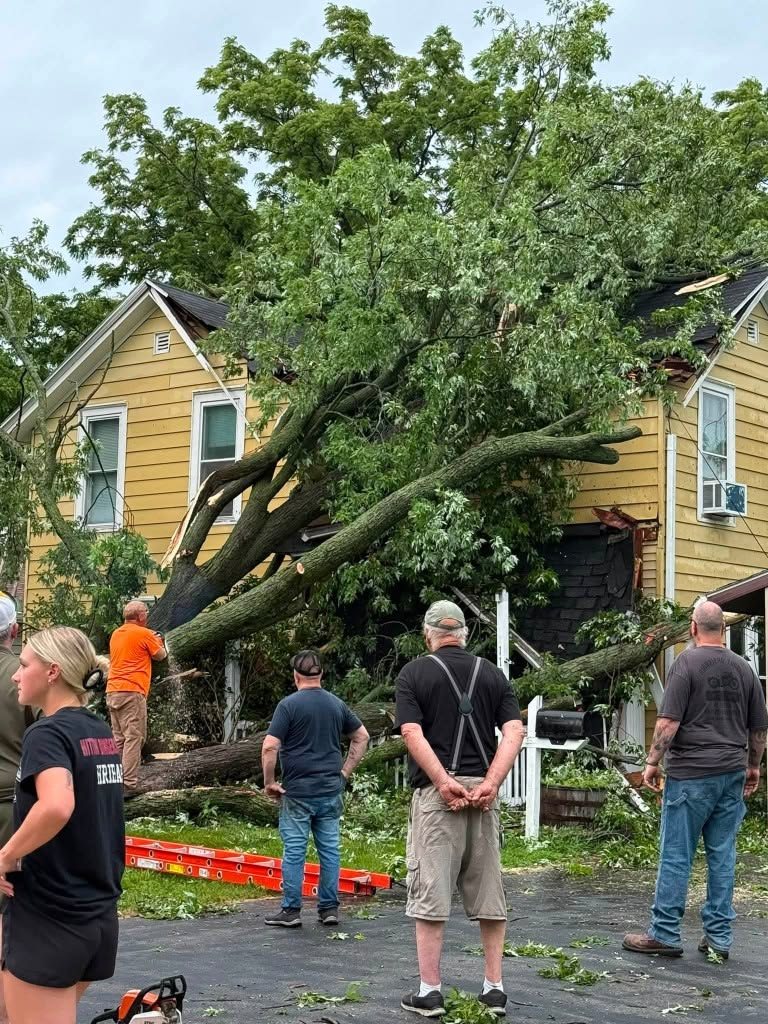
The peaceful appearance of this neighborhood has been completely changed by one powerful and unexpected moment. A huge tree has fallen across the property, its thick branches stretching in every direction and pressing against the yellow house as though nature itself has suddenly taken over the yard. The tree is so large that it is difficult to understand how much force was involved in bringing it down. Its trunk and enormous limbs now cover the grass, driveway, and parts of the house, leaving behind a scene filled with broken branches, leaves, and debris. The people gathered outside seem to be taking in the damage before beginning the difficult task of cleaning everything up. Some are standing silently and looking at the house, while others appear to be preparing tools and equipment. A bright ladder lies across the driveway, and a chainsaw is nearby, suggesting that the cleanup operation is about to become much more serious. Every large branch has to be handled carefully because the tree is resting against the structure, and moving one section without considering the others could create additional damage. What makes the scene particularly striking is the contrast between the beautiful green trees surrounding the home and the destruction caused by this single fallen tree. Just moments before the incident, this could have been an ordinary neighborhood filled with the familiar sounds of daily life. People may have been inside their homes, children may have been playing nearby, and cars may have been coming and going as usual. Then something changed. A powerful wind, severe weather, weakened roots, or another unexpected event may have caused the tree to break, sending its massive limbs crashing down. The sound must have been frightening. Heavy wood striking a roof can create a tremendous noise, and seeing a giant tree suddenly fall toward a home would leave anyone shocked. For the people who lived here, the first moments would likely have been filled with uncertainty. They would have needed to make sure everyone was safe before worrying about property damage. Once they knew nobody was seriously hurt, attention could turn toward the enormous amount of work waiting outside. The photograph seems to capture the beginning of that process. The people are not celebrating, and they are not simply standing around out of curiosity. They appear to be studying the situation and considering the safest way forward. The man wearing suspenders stands with his hands behind his back, looking toward the fallen branches as if carefully examining the damage. Nearby, another person watches the house, while someone else appears ready to assist with the cleanup. The woman in the foreground is moving through the scene, adding to the feeling that this is an active response rather than a staged photograph. The house itself carries an emotional weight. Its yellow exterior is bright and welcoming, but the broken tree makes the home look vulnerable. Parts of the roof and upper structure appear to be hidden beneath branches, and there are signs that the impact may have caused significant damage. A home is more than wood, siding, windows, and a roof. It contains family photographs, personal belongings, furniture, memories, and countless small objects that make everyday life feel familiar. When something crashes into it, the damage can feel deeply personal. Even if the structure can eventually be repaired, the family may remember the day for a very long time. They may remember the sound of the tree falling, the sight of branches covering the yard, the people who came to help, and the first moment they realized how serious the situation was. In difficult circumstances, those memories often become connected not only with fear but also with gratitude. When neighbors and workers arrive to help, the family suddenly realizes they do not have to face the disaster alone. A fallen tree of this size can require professional equipment, careful cutting, and coordinated teamwork. The largest pieces cannot simply be dragged away by hand. They must be cut into manageable sections and moved without causing additional harm to the house or anyone nearby. The ladder and chainsaw visible in the photograph suggest that this process has already begun or is being prepared. The work may continue for hours, and repairs to the house could take much longer. There may be insurance claims, structural inspections, roof repairs, yard cleanup, and the difficult process of replacing things that were damaged. Yet the first priority remains safety. Everyone has to respect the power of the fallen tree because even after it stops moving, branches can remain under tension and become dangerous when cut. The photograph therefore captures more than destruction; it captures the beginning of recovery. Every branch that is removed brings the property one step closer to normal. Every piece of debris carried away reveals more of the house and yard. Slowly, the chaos can become organized again. The driveway can be cleared, the damaged areas can be repaired, and the family can begin returning to their ordinary routine. The tree itself may eventually become part of the story of the home. Perhaps it once provided shade during hot summer days. Perhaps birds nested in its branches. Perhaps the family had watched it grow for years. Losing it could be emotional, even while they are grateful that everyone survived the incident. Trees often become silent landmarks in neighborhoods. People recognize a house because of the large tree in front of it, children play beneath its branches, and families become accustomed to seeing it every day. When that tree suddenly disappears, the entire appearance of the street can change. The empty space left behind may feel strange for a while. But nature also has a way of beginning again. After the cleanup and repairs, grass may grow back, new plants may be planted, and eventually another tree could take its place. The damaged house can become a symbol of recovery rather than destruction. The most powerful part of this photograph may actually be the people standing around the damage. They show that when something unexpected happens, people can come together quickly. A disaster can reveal the strength of a community. Neighbors may bring equipment, offer advice, help move debris, provide food or water, or simply stand nearby so the family knows they are not alone. Even a few extra hands can make a difficult cleanup feel more manageable. The people in the image seem united by a common purpose: understanding the damage and helping restore the property. There is something deeply human about that response. Nobody can undo the moment when the tree fell, but everyone can contribute to what happens afterward. They cannot change the past, but they can help shape the future. That is what resilience looks like. It is not pretending that nothing happened. It is looking at the destruction honestly and then deciding to rebuild. The yellow house may be covered by branches today, but it will eventually stand clear again. The driveway may be filled with leaves and pieces of wood, but it will eventually be cleaned. The broken limbs will be removed, the damaged sections repaired, and the family will once again be able to look at their home without seeing only the disaster. What happened here may have been frightening, but it does not have to be the end of the story. It can become the beginning of a new chapter. The image reminds us how quickly life can change. A familiar tree that once represented beauty and stability can become a source of danger in a matter of moments. A normal afternoon can become an emergency. A quiet house can suddenly become the center of a cleanup operation. But it also reminds us that people are capable of adapting. When circumstances change without warning, we look for solutions. We call for help, gather tools, assess the damage, and begin putting things back together. The people in this photograph are doing exactly that. They are facing a huge problem, but they are facing it together. Perhaps the family will eventually repair the roof, replace damaged materials, clean the yard, and plant something new. Perhaps the people who helped will move on with their own lives, but their kindness will remain part of the family’s memory. One day, the scene captured in this photograph may look completely different. The enormous branches will be gone, the driveway will be clear, and the yellow house will once again be visible in its entirety. The family may walk outside and see the repaired home standing where the damaged one once was. They may remember the fallen tree and realize how much has changed since that day. The photograph will then serve as a reminder of both the danger they experienced and the strength they discovered afterward. In the end, this is not only a story about a tree falling on a house. It is a story about unexpected change, human resilience, and the importance of people coming together when life becomes difficult. The broken tree represents the sudden challenges that none of us can predict, while the people standing around it represent the determination to recover. The house may have been damaged, but the spirit of the people around it remains strong. What looks like a scene of destruction can therefore also be seen as the first scene of rebuilding—a moment when the damage has happened, the shock is still fresh, but everyone is already looking toward the work of tomorrow.
The scene in this photograph looks like the aftermath of a powerful storm or sudden natural disaster, but behind the fallen tree is a story of a family, a home, and a neighborhood suddenly forced to come together. The enormous tree has collapsed across the property, with its thick trunk and heavy branches spreading over the yard and pressing against the yellow house. What was once a beautiful tree providing shade and character to the neighborhood has become a tangled obstacle that now needs to be removed carefully. The branches are so large that they almost look like they belong to a much bigger forest, yet they have landed directly in the middle of someone’s everyday life. The house appears surrounded by destruction, but the fact that people are already gathered around the property suggests that the most important thing has happened first: people have come to help. Looking at the photograph, it is easy to imagine how frightening the moment must have been when the tree finally came down. There may have been a sudden crack as the trunk began to split, followed by the tremendous sound of branches striking the roof and ground. Leaves and smaller branches would have scattered everywhere, and the people nearby may have rushed outside to see what had happened. For the family living in the house, those few seconds could have felt much longer. A familiar part of their property had suddenly become a dangerous mass of wood, and they would have had to wonder whether the house was structurally safe and whether anything inside had been damaged. Once the immediate shock passed, another reality would have appeared: the enormous cleanup ahead. The photograph shows several people standing around the fallen tree, and their presence gives the scene a sense of teamwork. One person appears to be examining the branches while others look toward the house and the areas where the tree has fallen. A ladder is lying across the driveway, and a chainsaw is visible nearby, suggesting that the process of clearing the property is beginning. Removing a tree this large is not something that can be rushed. Each branch has to be approached carefully, especially when heavy sections are resting against a building. The people working on the property have to think about where each piece will fall, how it can be safely cut, and how to prevent additional damage. What appears to be a simple pile of branches from a distance is actually a complicated and potentially dangerous cleanup operation. The yellow house makes the photograph particularly striking. Its warm color normally would make it look welcoming and peaceful, but the giant green tree covering the front of the property creates a dramatic contrast. The house seems almost hidden beneath nature’s power. Yet it remains standing, and that can be an important source of hope. Even when a home suffers serious damage, the structure can often be repaired piece by piece. Roofs can be replaced, windows can be repaired, damaged siding can be restored, and yards can eventually be cleaned. The process may be exhausting, but recovery is possible. For the family, the hardest part may not be the physical cleanup but the emotional experience of seeing their home suddenly changed. A home is filled with memories that cannot simply be moved out of the way. Every room may contain photographs, childhood belongings, furniture, gifts, and objects connected to years of family life. When a tree crashes onto a house, the damage can feel like an invasion of that private world. The family may have spent years creating a comfortable place, only to see part of it damaged within seconds. That is why the people standing outside are so important. Their presence means the family does not have to face the situation completely alone. In moments of disaster, even having someone nearby can provide comfort. A neighbor can help move debris. A friend can bring tools. A worker can explain what needs to happen next. Someone can simply stand nearby and say, “We will get through this.” Those actions may seem small, but they can make an enormous difference when someone is overwhelmed. The photograph captures a moment when the neighborhood appears to have paused to deal with the unexpected. People who may normally pass each other without speaking are suddenly standing together because something has happened that requires cooperation. Disasters have a strange way of bringing communities closer. They remind people that no one is completely independent and that there will be times when everyone needs a helping hand. The fallen tree has created a problem for one property, but the response becomes a shared responsibility among the people who care about the neighborhood. Perhaps someone knows how to operate a chainsaw safely. Perhaps another person has a truck that can haul away the branches. Someone else might know a professional who can inspect the roof. Each person can contribute something different, and together those contributions can turn an overwhelming situation into a manageable plan. The tree itself may also have a history. It could have been standing there for decades, growing through different seasons and storms. Generations of people may have walked past it without ever imagining that one day it would fall. Birds may have built nests in its branches, children may have played beneath it, and families may have enjoyed its shade during warm afternoons. Trees become part of the identity of a neighborhood because they are there for so long. Their presence becomes ordinary, almost invisible, until something changes. Seeing such a massive tree lying across a home is therefore not only shocking because of the damage; it is also a reminder that nature is constantly changing. The tree that once represented strength and stability has reached the end of its life in that particular place. The family may eventually have to say goodbye to it, even while being grateful that everyone survived the incident. There can be sadness in losing something beautiful and familiar, but there can also be relief when the danger is finally removed. After the branches are cut away, the yard may look strangely empty. Sunlight may reach parts of the property that were previously shaded, and the house may look different without the enormous tree beside it. Eventually, however, new plants can grow, a new tree can be planted, and the property can begin to develop a new appearance. The family will create new memories there, and the fallen tree will become a story they tell about a surprising day in their lives. The people who helped may also become part of that memory. Years later, the family may remember not only the frightening moment when the tree fell but also the people who arrived afterward. They may remember who helped cut branches, who checked on them, who offered equipment, and who stayed until the work was finished. Those moments of kindness often become the part of a disaster story that people remember most fondly. The photograph is powerful because it captures the transition between destruction and recovery. The damage is still visible everywhere, but so is the beginning of the solution. The tools are present. The people are present. The work is about to begin. This is an important moment because recovery rarely happens all at once. It happens through dozens of small actions. One branch is removed. Then another. The driveway is cleared. The roof is inspected. Broken pieces are carried away. Repairs are planned. Insurance is contacted. Slowly, the overwhelming disaster becomes a series of smaller tasks that can be completed one by one. That is how people rebuild after unexpected events. The photograph can therefore be seen as a lesson in resilience. The fallen tree represents the problems in life that arrive without warning. Nobody planned for it to happen, and nobody could simply undo the event. But once it happened, the people had a choice: they could remain overwhelmed by the destruction, or they could begin working toward recovery. The people in this image appear to have chosen the second option. They are looking at the damage, assessing what needs to be done, and preparing to move forward. There is also something inspiring about the ordinary appearance of the people involved. They are not superheroes or emergency characters from a movie. They are everyday people wearing ordinary clothes, standing in an ordinary neighborhood, dealing with an extraordinary problem. That is often what real courage looks like. It is not always dramatic. Sometimes courage is simply showing up when someone needs help. Sometimes it is picking up a tool and helping clear a fallen branch. Sometimes it is staying with a neighbor during a stressful day. The scene demonstrates that ordinary people can accomplish extraordinary things when they work together. The house may have been damaged, but the community surrounding it appears strong. The fallen tree may have blocked the driveway, but it has not stopped people from moving forward. The destruction may look overwhelming, but the first steps toward rebuilding are already visible. Eventually, the branches will be gone, the driveway will be cleared, and the house will begin to look like itself again. The family will repair what was damaged and perhaps plant something new in the place where the old tree once stood. The neighborhood will return to its normal rhythm, but this day will remain part of its history. Whenever someone looks at the photograph, they may remember the enormous tree that came down, the yellow house beneath it, and the group of people who gathered to help. What began as a frightening event can ultimately become a story about strength and community. The photograph reminds us that we cannot always control what happens around us. Storms arrive, trees fall, accidents happen, and plans can change in an instant. But we can control how we respond. We can help. We can stay calm. We can stand beside someone who is having a difficult day. We can turn a frightening situation into an opportunity to show compassion. That is what makes this photograph more than a picture of property damage. It is a picture of people facing an unexpected challenge together. Beneath all the branches and broken wood is a home that will eventually be restored, and surrounding that home are people who are already taking the first steps toward making that possible. The tree may have fallen, but the spirit of the people standing around it has not. The destruction is temporary, the cleanup will eventually end, and the house will once again become a place of safety and comfort. What will remain is the memory of how quickly everything changed and how many people came together afterward to help put things back together. In the end, the photograph tells a story of loss, but even more importantly, it tells a story of recovery. It reminds us that when life brings something unexpected crashing down, we may not be able to prevent the damage, but with patience, courage, and the support of others, we can always begin rebuilding.The photograph captures a neighborhood frozen in the middle of an unexpected disaster, where a beautiful old tree has fallen across a yellow house and transformed an ordinary day into a moment that everyone will remember. The enormous trunk stretches across the property like a fallen giant, with heavy limbs tangled together and branches covering the grass, driveway, and parts of the home. Leaves are scattered everywhere, showing how violently the tree came down. The house looks almost hidden beneath the greenery, and the contrast between the bright yellow walls and the dark, broken branches makes the damage especially dramatic. It is easy to imagine how different this place looked only a short time before the photograph was taken. The tree may have stood proudly beside the house for many years, providing shade during hot afternoons, shelter for birds, and beauty for everyone who passed by. To the people living there, it may have been such a familiar part of the property that they rarely thought about it. Then, suddenly, something caused it to fall, and an ordinary piece of the landscape became the center of an emergency. The moment a massive tree begins to fall is one that happens incredibly quickly, but the consequences can last for days, weeks, or even longer. There may have been a tremendous cracking sound as the wood broke, followed by the thunderous impact of branches striking the roof and ground. Leaves would have shaken loose, smaller branches would have snapped, and the peaceful yard would have been transformed almost instantly. The family inside the house may have been terrified, wondering whether the roof would hold and whether everyone was safe. After the initial shock, they would have stepped outside to discover the enormous scale of the damage. What they saw must have been difficult to process. A tree that had once stood upright was now lying across their home, and the property was covered in debris. But the photograph also shows something encouraging: people have gathered. Instead of leaving the family alone to face the disaster, several people are standing nearby, studying the situation and preparing to help. Some appear to be workers, while others may be neighbors or people connected to the cleanup. Their presence changes the feeling of the photograph. Without them, the image would simply be about destruction. With them, it becomes a story about recovery. A bright ladder lies across the driveway, and a chainsaw can be seen nearby, suggesting that the difficult process of removing the tree is about to begin. The size of the branches makes it clear that this will not be an easy job. A fallen tree of this magnitude cannot simply be pulled away. The branches need to be cut into smaller sections, and each section has to be handled carefully so that it does not cause further damage. The people working around the property have to think about the weight of the wood, the position of the limbs, the condition of the house, and the safest direction for each cut. One wrong move could create another problem. That means patience and teamwork are just as important as strength. The men standing in the driveway appear to be observing the tree before deciding what to do next. Perhaps they are discussing where the first cut should be made. Perhaps someone is checking the roof while another person examines the trunk. In a situation like this, everyone has a role. The cleanup may begin with the smallest branches before the larger pieces are tackled. Once the branches are removed, the main trunk can be cut into sections and carried away. After that, the damaged areas of the house can finally be inspected properly. What looks like one disaster from the outside is actually a long series of tasks that must be completed one at a time. The yellow house adds an emotional dimension to the photograph because it represents someone’s home and daily life. A house is where people expect to feel safe. It is where families eat meals, sleep at night, celebrate birthdays, keep photographs, store childhood memories, and return after long days. When a tree crashes onto it, the damage is not merely physical. The sense of security can be shaken as well. The family may suddenly find themselves worrying about whether they can stay inside, what repairs will cost, and how long it will take for everything to feel normal again. They may have to deal with insurance, contractors, temporary repairs, and the possibility of damaged belongings. Even after the tree is removed, the emotional memory of that day can remain. Yet difficult experiences often reveal something important about the people around us. A crisis can show who is willing to stop and help. The people in this photograph appear to have done exactly that. They have gathered around the property instead of simply passing by. Perhaps they were called by the family, or perhaps they saw what happened and offered their assistance. Whatever brought them there, their presence represents the strength of a community. When something goes wrong, neighbors can become incredibly important. Someone may have a chainsaw. Someone else may have a ladder. Another person may have experience with tree removal. Someone might know a roofing contractor. Another person may simply provide encouragement. All of these things can help transform a frightening situation into a manageable one. The woman in the foreground seems to be moving through the scene, while the people farther back remain focused on the fallen tree. Their different positions make the photograph feel like a genuine moment rather than a carefully arranged picture. Nobody appears to be posing. Everyone is simply responding to what has happened. That makes the image feel immediate and real. The fallen tree also reminds us how powerful nature can be. Trees are often associated with stability because they remain in one place for decades, growing slowly and quietly. We see them through every season and begin to assume that they will always be there. But trees are living structures, and weather, age, disease, weakened roots, soil conditions, or strong winds can eventually make them vulnerable. When a tree this large falls, it demonstrates just how much energy nature can release in a single moment. Something that once seemed permanent can suddenly be lying across a house. The event may also make the family and neighbors look differently at the other trees around them. They may begin wondering which ones are healthy, which branches are weakened, and which trees might need professional inspection. One fallen tree can change the way an entire community thinks about safety. There is also a quiet sadness in seeing such a massive tree destroyed. Even while everyone is focused on the house, the tree itself represents something that cannot simply be restored. It may have been decades old. It may have watched generations of families come and go. It may have provided shade for countless summers and shelter for birds and squirrels. Now its branches lie broken across the property. The family may eventually miss the tree even after the danger has passed. The empty space it leaves behind could make the yard look completely different. Sunlight might reach places that were previously shaded, and the familiar view from the windows may change forever. But nature also offers the possibility of renewal. Once the damaged tree is removed, the family can clean the yard and eventually plant new trees or other plants. A new tree will not replace the old one immediately, but over time it can grow into another part of the family’s story. The damaged house, too, can become a symbol of rebuilding. Repairing a home after a major incident is rarely easy, but every completed repair represents progress. The first day may be filled with shock and uncertainty. Later comes cleanup. Then inspection. Then repairs. Eventually the house can begin to look normal again. The family can put their belongings back in place, repaint damaged areas, replace broken materials, and slowly stop thinking about the disaster every time they walk outside. The day will eventually become a memory instead of an ongoing crisis. The photograph captures the earliest stage of that journey, when the damage is still fresh and the solution has only just begun. It shows the moment between “What happened?” and “What do we do now?” That moment can be overwhelming, but it can also be the beginning of resilience. Resilience does not mean pretending that the disaster was not painful. It means accepting what happened and finding the strength to move forward. The people gathered around this house are already doing that. They cannot make the tree stand again, but they can remove it. They cannot erase the damage, but they can repair it. They cannot change the past, but they can protect the future. That is the quiet message hidden in the photograph. The scene may look chaotic, but there is a sense of purpose among the people standing there. Everyone is looking at the same problem and trying to find a way through it. Perhaps someone is thinking about the safest way to cut the largest limb. Perhaps another person is wondering whether the roof needs immediate reinforcement. Someone else may be calculating how much wood needs to be removed. These decisions may seem ordinary, but together they are the first steps toward restoring the home. The scene also reminds us that not every hero is wearing a uniform. Sometimes the people who make the biggest difference are neighbors who simply show up with tools and a willingness to work. They may spend hours clearing branches without expecting recognition. They may get tired, dirty, and frustrated, but they continue because someone needs help. Community is often built through exactly these moments. People may not know each other well before a disaster, but working side by side can create connections that last for years. The family may remember the faces of the people who helped them long after the tree has been removed. They may remember who stood in the driveway, who helped clear the yard, who offered advice, and who stayed until the difficult work was finished. Those memories can become a source of gratitude. The photograph therefore contains two stories at once. The first is the story of a powerful tree that fell unexpectedly and damaged a home. The second is the story of people responding to that disaster with determination and cooperation. The first story is about nature’s power; the second is about human strength. Together, they create a much more meaningful picture. The tree may be enormous, but it is surrounded by people who are already preparing to take control of the situation. The house may be damaged, but it is still standing. The yard may be covered in debris, but the tools needed for cleanup are already there. These details suggest that the situation, although serious, is not hopeless. There is a path forward. It will take time, effort, money, patience, and perhaps professional help, but the home can be restored. The family can eventually look back on this photograph and remember not only the day their tree fell but also the day their community showed up for them. Perhaps years later, the repaired yellow house will look completely different from the scene in this image. The roof will be fixed, the yard will be clean, and new plants will grow where the fallen tree once stood. A new tree might eventually rise near the house, starting a new chapter. Children may play beneath it, birds may return to its branches, and future residents may never know the full story of what happened there. But the photograph will preserve the moment when the old tree came down and everything changed. It will remind the family of how fragile normal life can be and how powerful people can be when they respond together. Ultimately, this image is not simply about a fallen tree or a damaged house. It is about unexpected events and the human ability to recover from them. Life can sometimes change in a single moment, just as this tree appears to have changed the entire property in an instant. But recovery also happens one moment at a time. One branch is removed, one repair is completed, one room is restored, one day passes, and eventually the family begins to feel at home again. The destruction may be temporary, but the lessons can last a lifetime. The people in this photograph show that when something enormous falls into our path, we do not necessarily have to face it alone. There are neighbors, friends, workers, and communities willing to stand beside us. And sometimes, in the middle of the biggest mess, the first sign of hope is simply seeing people arrive, bring their tools, look at the damage, and begin asking the most important question: